

GuideGrok Bot
Grok Bot as Head of Content: What an 11-Bot Team Gets Right, and When One Bot Is Enough
TL;DR
- The system: @ryangrowthh's 11-bot content team, run by a Chief of Staff bot across three departments: Research, Creating and Tracking. The ~2M impressions figure is self-reported.
- What to borrow: brand context before automation, a voice document stored as a file, one narrow job per bot, and a person approving every post.
- What the author does in practice: runs "only 3-4 bots at a time" to save usage, and writes most copy by hand.
- The test before adding bots: draw your pipeline as arrows. Bots that only wait on each other are one job split into steps. Six bots at 70% parallel work give about 2.4x speed, not 6x (the author's math).
- Start with two: a chief that holds brand context, and one bot that makes content. The docs also say to start with "the smallest useful roster".
Eleven bots running one person's content sounds like overkill, and sometimes it is. But the system @ryangrowthh published in October 2026 gets several things right that a one-bot setup often misses. Here's what to borrow, and the test for whether you need all eleven.
The system
@ryangrowthh's guide opens: "My team of 11 Grok Bots helped me generate ~2M impressions in my first two weeks of posting on 𝕏." That's the author's reported result. The guide is upfront about what else went into it: "this system still requires taste and manual curation", and "Part of why I've achieved these results is my existing skills and experience." The author has been "in content for 6 years."
The structure: a Chief of Staff manages three departments, "Research (pre-production, ideation)", "Creating (drafting, images, angles)" and "Tracking (post-production)". The ten bots under it include an 𝕏 Researcher that "sends me a full report of 30 ideas every morning", a Competitor Watch, a Bookmarks Brain, a QT Scout, an Ideas Sparring Bot, an 𝕏 Writer, a Banner and Visuals bot, a Fact Checker, an Article Tracker and an Analytics Analyst. The guide includes a prompt for each bot.
What it gets right
Brand context before automation
The Chief of Staff comes first. The guide suggests picking "the premade Chief of Staff" when Grok Bot asks you to create your first bot, and says: "This Bot needs full brand context before we launch the content subagents." It scans your existing content and your 𝕏 profile, writes a summary brief, and interviews you.
Borrow this: don't create a content bot until your first bot can describe your brand back to you accurately.
A voice document stored as a file
The guide has the bot "build a markdown file of your voice - pulled from previous posts." It also says to "Keep a markdown file for each Bot" covering "its task list, voice, dos/don'ts, and so on." A file is something every later bot can read, and you can edit it yourself.
Narrow jobs
"If you mix 2+ roles, quality rapidly declines." That matches the docs, which warn that a vague job such as "General Helper gives the Bot less guidance and makes its saved context harder to reuse."
Let the chief suggest the team
Rather than copying the eleven, the guide says to "prompt your COS to suggest specific team members based on your brand."
A person approves everything
"my bots never publish or reply on my behalf. I still edit every single angle, topic, and draft myself." The 𝕏 Writer bot is described as unfinished: the author notes that "90%+ of this article is manual".
What it costs, in the author's own words
"Rotate bots. I run only 3-4 bots at a time, and only a few have daily routines. If you run all 11 at once, you'll burn usage." So the eleven are a roster, not eleven bots running all day. That detail matters more than the headline number.
Scheduling through a browser
@natecurtiss_yt made a related point: "auto-schedulers kill your reach on social media, but grokbot has a browser that can schedule your videos like a human."
The reach claim is that poster's opinion, and we can't measure it. The practical point holds: a bot with a browser can use a platform's own scheduler the way you would. Check each platform's rules on automated use first.
Media generation, via a partner
Runway announced: "Runway MCP is now in Grok Bot."
We found no matching changelog line or @bot post, so treat this as Runway's own announcement. Separately, the Official changelog for v0.75.2 (Oct 22, 2026) says "Bots can create videos from a description or from an image you share", so you may not need a partner tool for simple clips. The guide itself generates images in outside tools and has its Banner bot write only the prompts.
The arrow test: do you need eleven?
@rvaniaaaa's critique of bot teams is the right check here: "Six bots in a chain run exactly as fast as one."
The method: "draw the team as arrows and delete every arrow that carries no data." If the writer waits on the researcher and the editor waits on the writer, you have one job in steps, plus handoffs. The article runs the numbers: "Six bots, 70% independent work: 2.4x, not 6x." It notes this "is the formula applied to example values, not a measurement of Grok Bot."
It also quotes the docs' advice, "Ask for a single owner at each stage", and warns that "Two bots can keep sending each other revisions". The fix it suggests: "a hard cap on handoffs per task, and no more than two rounds in a row without progress."
The docs' own guidance on rosters points the same way: "Start with the smallest useful roster", and "Add another Bot only when the work has a stable specialist role."
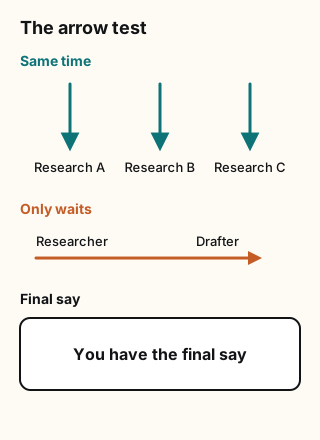
Figure explanation: Three arrows labeled Research A, Research B, and Research C run side by side under Same time. Below them, one arrow holds both a researcher and a drafter under Only waits. A last box says you have the final say. The diagram is a simplified reading of the arrow test, not a picture of a real team.
What this means for you
Draw your content pipeline on paper, then go through these questions:
- Which bots can run at the same time? Researching three topics can happen in parallel. That's a real reason for more than one bot. In the 11-bot system, Researcher, Competitor Watch and Bookmarks Brain don't depend on each other.
- Which bots only wait? A writer that always waits on one researcher can usually be the same bot.
- Who has the final say? One owner per stage, and you at the end.
- What stops a loop? Cap revisions between any two bots, for example at two rounds.
- What runs on a schedule? Give daily routines only to the bots that need them, like the morning ideas report and the analytics report. Run the rest on demand.
A starter setup:
- Week 1: a Chief of Staff with brand context and a voice file.
- Week 2: add one maker bot, either research or a writer, whichever saves you more time.
- Week 3 and later: add a bot only if it can run in parallel or needs different connections. Remove it if it doesn't save time within two weeks.
Tradeoffs and caveats
- Results aren't portable. The ~2M impressions were self-reported by an experienced creator who still writes most copy by hand. Expect your own results to depend on your skill, niche and posting history.
- More bots means more usage. Each daily routine runs whether or not it finds anything. The author's fix is rotation.
- More bots means more to maintain. Eleven voice and rules files can drift apart. A single voice file every bot reads is easier to keep consistent.
- One computer. All your bots share files and sign-ins. A separate bot isn't a security boundary.
- Platform rules. Automating posting or scheduling through a browser can conflict with a platform's terms. Keep posting decisions, and the posting itself, in your hands.
For more on when not to add a bot, see our series The Bot Team That Ships.
Sources
Checked October 24, 2026.
Start from a template
People share Grok Bots you can add and then change to fit your job. Each template opens on x.ai. bot.ski never installs anything.