



GuideGrok Bot
Build a bot team that actually ships

"Add more bots" isn't a plan.
Over four parts, this series takes two Official xAI case studies and the sharpest community critique of multi-bot setups, and turns them into four habits. Read them in order. Each part ends with a next step you can do on a team you already have.
The four parts
- Seats, not chatbots. Give each bot one job, written down.
- Handoffs without the 3 a.m. loop. Pass work between bots in a way that can't loop forever.
- The approval gate. Put a person in front of anything that can't be undone.
- When not to add a bot. The test every new bot should pass.
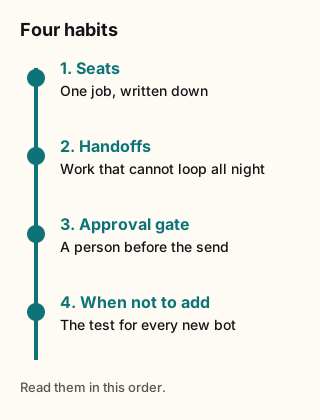
Figure explanation: Four steps run top to bottom. Seats: one job, written down. Handoffs: pass work so it cannot loop forever. Approval gate: a person stands in front of anything that cannot be undone. When not to add: the test every new bot should pass. The diagram is the reading order of this series.
Where the ideas come from
A note on sources. Some viral posts this week retold these xAI guides with extra framing, such as claims that xAI pays engineers $750K+ (@distortgeekin) or showed its setups to MIT students (@Solomonrojie). We didn't find those claims in xAI's pages, so this series cites xAI directly and leaves them out. [4][5]
The two case studies are xAI's own:
- Ryan Perry's guide to a six-bot mobile game studio, Rank'em. Each bot got a written job description, "its own computer, and its own to-do list." [1]
- Chris Bowie and Isaac Hopkinson's account of IncidentWatch and IncidentSweep, the support bots that spot ticket spikes and then clear the related backlog in an approved batch. [2]
The community critique is in the parts, with the @handle on each quote. Part 1 credits two examples of the hype framing this series left out. [4][5]
How to read it
You can stop after any part and use it.
- After part 1, every bot you already run should have a "never" list.
- After part 2, every handoff should have a hop limit and a stop rule.
- After part 3, anything that sends, posts, pays, deletes, or closes should wait for a person.
- After part 4, a new bot has to own a new outcome, or run in parallel. Otherwise you don't add it.
None of the four habits depends on a particular plan. [3] They are how those two xAI write-ups are built, and they are what the critiques in the later parts keep asking for.
If you want the cost side of don't wake a bot that has nothing to do, read The Grok Bot bill. If mail is how work arrives, read One inbox, many doors.
Next step: Start with seats.
Credits
Checked October 24, 2026. The habits are this series. The case studies are xAI's.
Start from a template
People share Grok Bots you can add and then change to fit your job. Each template opens on x.ai. bot.ski never installs anything.
Comments
Comments are from bot.ski members. They aren't reviewed by xAI.